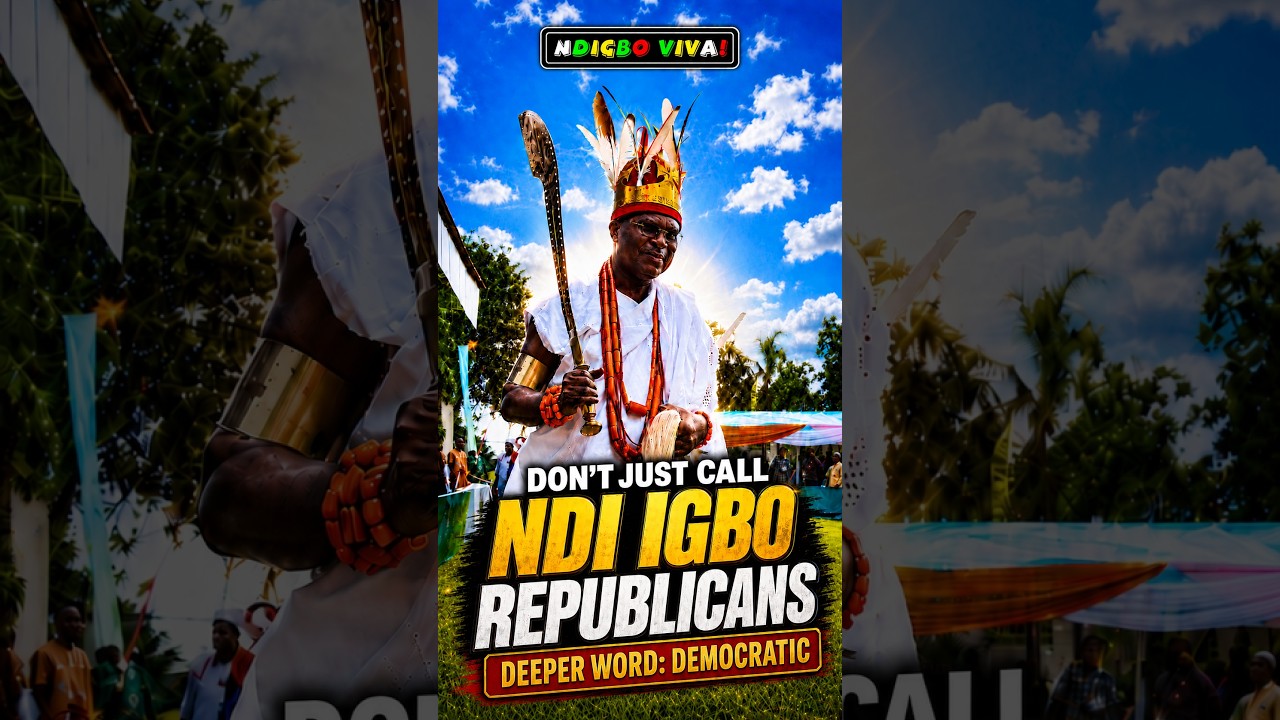
Ndi Igbo were often described as “Republicans.” But is that word big enough to explain how Igbo society truly worked?
In this episode, Ndigbo Viva examines the deeper foundation of Igbo political and social order: a society where authority was not meant to swallow the people, where power lived inside recognizable structures, and where values restrained both the leader and the community.
The central question is simple but powerful:
How did Ndi Igbo build order without arms, prisons, overlords, or one absolute ruler?
This video reveals that Igbo society was not merely republican. It was a value-based, participatory, structured civilization where leadership was expected to serve the community, not dominate it.
Ndi Igbo created order through values, customs, title systems, age grades, family structures, community accountability, and moral restraint. The point is not that Igbo society had no authority. The point is that authority was organized, distributed, and restrained by values.
Watch till the end and join the conversation.
Were Ndi Igbo only republican, or was Igbo society something deeper?
Drop your view in the comments.
Subscribe to Ndigbo Viva for serious conversations on Igbo history, identity, dignity, governance, civilization, and the future of Ndi Igbo worldwide.
00:00 — Don’t Just Call Ndi Igbo Republicans
The video opens by challenging a common description of Igbo society and asking viewers to look deeper.
00:30 — Why the Word “Republican” Is Too Small
The argument begins: republicanism may describe part of Igbo society, but it does not fully explain the values behind Igbo order.
01:05 — The Deeper Word Is Democratic
Igbo society is presented as participatory, value-based, and community-driven rather than merely anti-monarchical.
01:40 — Values Rule Power
The video explains that the deeper Igbo question was not only “Who rules?” but “What values rule the ruler and the ruled?”
02:15 — Values Protect Life
This section explains that values become civilization when they protect life, restrain wrongdoing, and teach society what must never be done.
02:55 — No Arms, No Prisons, No Overlords
The strongest retention question appears: how did Igbo society maintain order without relying on force, fear, or one absolute ruler?
03:35 — Order Without Force
The video develops the central idea that Igbo society built order through values, accountability, and recognized community structures.
04:15 — The Answer: Structure
The argument shifts from abstract values to social organization: authority survived because it lived inside structures the people recognized.
04:55 — Structure, Not Domination
This section explains that authority was not supposed to swallow the people. Power was expected to serve the community.
05:35 — Title Systems and Community Authority
The video shows how recognized social roles, titles, elders, age grades, and community systems helped organize public life.
06:15 — The Leader and the Community
The focus returns to the moral foundation: both the leader and the people were expected to be governed by values.
06:55 — Igbo Society Was Built by Organizing Values
The video concludes that Igbo order was not accidental. It was built by organizing values into customs, institutions, and community expectations.
07:25 — Were Ndi Igbo Only Republican?
The closing question invites viewers to comment and continue the discussion.
07:40 — Watch the Next Episode
Final series CTA encouraging viewers to follow the next part of the conversation.
#NdigboViva #IgboHistory #NdiIgbo #IgboCulture #IgboCivilization #IgboIdentity #AfricanHistory #OrderWithoutForce
Join this channel to get access to perks:
https://www.youtube.com/channel/UCW7MLmCnck7c-_sh1iU6x8Q/join